What Is Wake Forest University Known For?
What’s Covered:
- Overview of Wake Forest University Admissions
- Unique Aspects of Wake Forest University
- What Are Your Chances of Acceptance at Wake Forest?
Are you looking for a small-ish school located within driving distance of mountains and beaches, and NCAA Division I athletics teams? If so, Wake Forest University may be the perfect college for you! Keep reading to learn about what it’s like to be a student at Wake Forest, including academics, extracurriculars, traditions, and the admissions process.
Overview of Wake Forest University Admissions
Location: Winston-Salem, North Carolina
Undergraduate Enrollment: 5,490
Acceptance Rate: 22%
Middle 50% SAT: 1420-1500
Middle 50% ACT: 32-34
Wake Forest University admissions are selective—only 22% of applicants are accepted. To increase your chances of acceptance, you should first meet or exceed the academic standards of previously accepted students. Then, it’s important to have impressive extracurriculars and standout essays.
It’s important to note that standardized testing has been optional at Wake Forest since 2008. However, you should generally submit your SAT or ACT score if it is above the 25th percentile, as students with scores are accepted at higher rates than those without.
Unique Aspects of Wake Forest University
Academics
Wake Forest University offers more than 50 undergraduate majors and 60 undergraduate minors in its seven colleges and schools:
- Undergraduate College
- Graduate School of Arts & Sciences
- School of Business
- School of Divinity
- Wake Forest Law
- School of Medicine
- School of Professional Studies
The most popular fields of study include business and marketing, the social sciences, biological and life sciences, and communication and journalism. Over the past seven years, 82% of graduates declared a second major and/or one or more minors.
Notable faculty include Anthony Atala, the director of the Wake Forest Institute for Regenerative Medicine, who is considered a national pioneer in organ growth, and David Carroll, a professor of physics and director of the Center for Nanotechnology and Molecular Materials, known for his research in nanoengineered cancer therapies.
Wake Forest University has a notable business school, which offers bachelor’s degrees in:
- Finance
- Business and Enterprise Management
- Decision Analytics
- Accountancy
Wake Forest University is also known for its study abroad culture. Over 80% of Wake Forest undergraduates have studied abroad in recent years. Wake Forest owns three residential study centers abroad in Venice, London, and Vienna. Many students take advantage of these study abroad opportunities, as well as the university’s other 400 study abroad programs in 200 cities across over 80 countries around the world.
Extracurriculars
Wake Forest University offers over 250 student organizations, including a number of fraternities and sororities. About 30% of Wake Forest men join fraternities, and about 60% of women join sororities.
Wake Forest is the smallest school in the Atlantic Coast Conference and offers NCAA Division I athletics for football, basketball, field hockey, soccer, tennis, and other sports. The teams are called the “Demon Deacons” and have won a total of 11 NCAA team national championships in sports, including:
- Women’s golf
- Field hockey
- Men’s golf
- Men’s soccer
- Men’s baseball
- Men’s tennis
Wake Forest is part of “Tobacco Road” or “The Big Four”, terms that refer to the four North Carolina schools (Duke, North Carolina, and North Carolina State) that have a strong rivalry within the ACC.
Wake Forest also offers club and intramural sports for non-student athletes, which many students take advantage of. In fact, 90% of the student body participates in at least one intramural team or individual sport.
Traditions
Wake Forest has several traditions for students to participate in. Some of the most popular include Project Pumpkin, Wake ‘N’ Shake, and Hit the Bricks.
- Project Pumpkin is an annual event that brings children from local schools to Wake Forest’s campus for a fall festival featuring trick-or-treating and educational activities.
- Wake ‘N’ Shake is a 12-hour dance marathon focused on curing cancer, which has raised more than $3.5 million since its inception in 2006.
-
Hit the Bricks is an annual philanthropic event that benefits the Brian Piccolo Cancer Drive.

[amp-cta id="9459"]
Dorms
Wake Forest University has a variety of housing options for students. Wake Forest guarantees housing for students during all four years of their undergraduate degree. Students must live on campus for three years unless they live with a parent or guardian in the Winston-Salem area. Overall, 68% of undergraduates live on campus.
First-year students cannot select their roommates or residence halls, but instead, roommates are matched based on a handful of roommate compatibility questions that highlight lifestyle habits and values.
There are eight first-year residence communities:
- Angelou Residence Hall
- Babcock Residence Hall
- Bostwick Residence Hall
- Collins Residence Hall
- Hopkins Residence Hall
- Huffman Residence Hall
- Johnson Residence Hall
- Luter Residence Hall
Financial Aid
Wake Forest University offers a limited number of merit-based scholarships—fewer than 3% of first-year applicants receive one. However, most financial aid at Wake Forest is determined by financial need—the university meets 100% of the demonstrated financial need of eligible undergraduate students.
Resources
Wake Forest University is located less than a mile from Reynolda Village, Reynolda Gardens, and the Reynolda House Museum of American Art. These properties were formerly part of the 1,067-acre estate belonging to R.J. Reynolds, founder of the R.J. Reynolds Tobacco Company.
- Reynolda Village is a shopping center with shops, restaurants, and service providers.
- Reynolda Gardens include woodlands, wetlands, fields, and formal gardens. They’re open daily with free admission and are a popular place for students to walk around, study, and exercise.
- The Reynolda House Museum of American Art is a museum that displays American art dating back to colonial times.
Location
Wake Forest is located in Winston-Salem, just 30 minutes from Greensboro, North Carolina. It is just under 150 miles from the mountains in Asheville, North Carolina, and just under 300 miles from the coastal cities of North Carolina, making it possible for weekend trips to the mountains and the coast.
What are Your Chances of Acceptance at Wake Forest University?
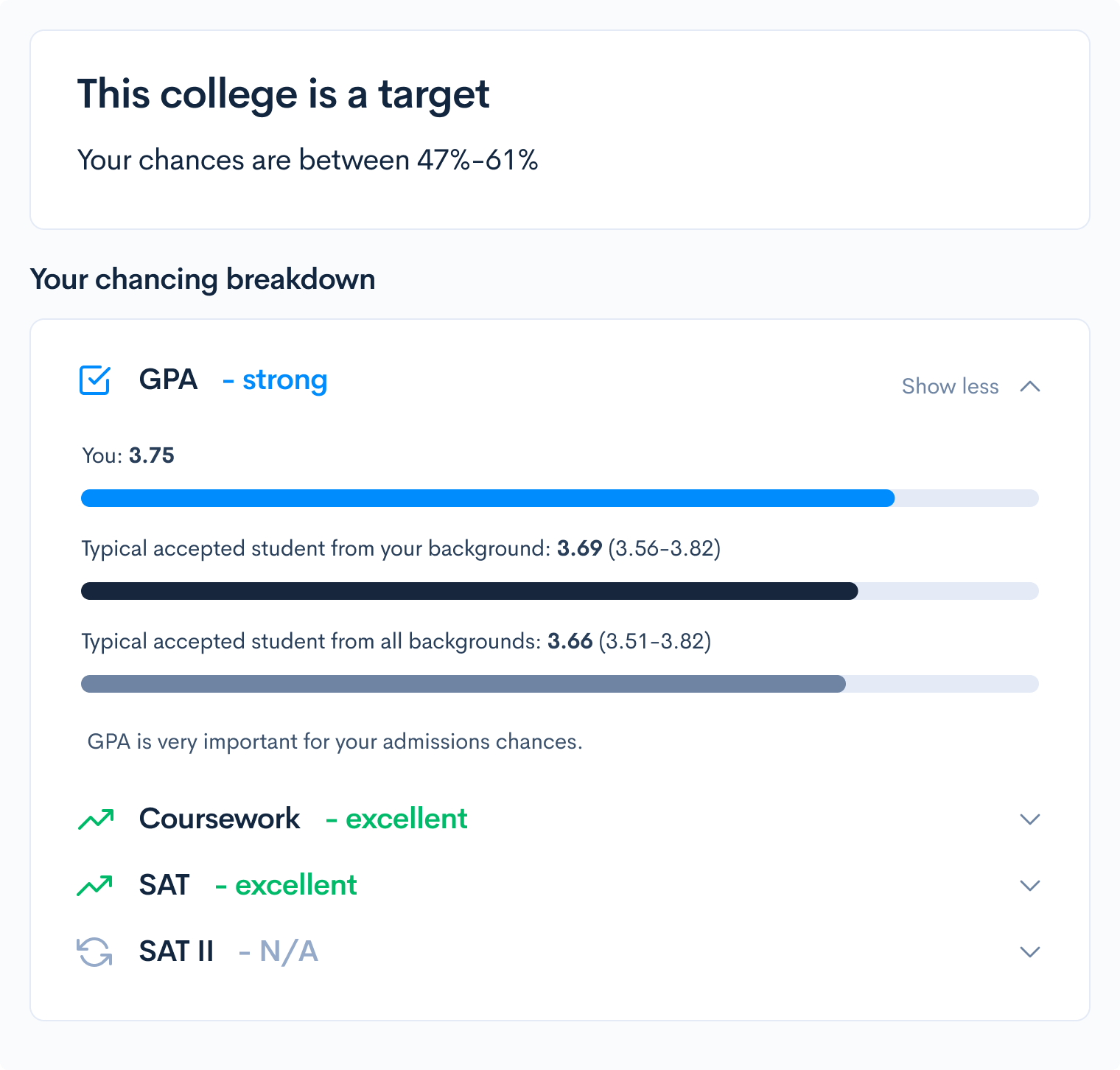
Even though Wake Forest University has a low admissions rate, your chances of acceptance may be higher than those of other students based on your unique combination of test scores, extracurriculars, class rank, and more.
To have a better understanding of your chances of acceptance at Wake Forest University, utilize our free chancing calculator. We’ll estimate your odds of acceptance based on your background, grades, test scores, and other important factors, and we’ll give you tips on how to improve your chances.
Based on your results, you can explore a list of best-fit schools to create a reliable strategy for the college application process.