What Is Tulane University Known For?
What’s Covered:
- Overview of Tulane University Admissions
- Unique Aspects of Tulane University
- What Are Your Chances of Acceptance at Tulane University?
If you’re looking for a school that offers the benefits of a large research university, the one-on-one direction of a small liberal arts school, and access to one of the most vibrant, culturally rich, and historical cities in the U.S., Tulane University may be the perfect fit for you.
From dorm options and financial aid packages to an in-depth look at the admissions process, keep reading to learn everything you need to know about Tulane University.
Overview of Tulane University Admissions
Location: New Orleans, Louisiana
Undergraduate Enrollment: 6,839
Acceptance Rate: 14%
Middle 50% SAT: 1430-1500
Middle 50% ACT: 32-34
Tulane University is a private liberal arts university located in New Orleans, Louisiana. Tulane University has a highly competitive admissions process—of the 432,942 students who applied during the 2025-2026 application cycle, 4,763 were accepted.
Tulane University prioritizes a student’s high school course rigor, class rank, academic GPA, and extracurricular activities when making admissions decisions. They also value the student’s standardized test scores, application essay, and recommendations.
How to Apply to Tulane University
Students who are interested in applying to Tulane University have the following application options:
|
Application Plan |
Application Deadline |
Notification Date |
|
Early Action |
November 10 |
January 10 |
|
Early Decision I |
November 1 |
December 15 |
|
Early Decision II |
January 15 |
February 15 |
|
Regular Decision |
January 15 |
April 1 |
During the 2025-2026 admissions cycle, 2,077 students applied Early Decision, of which 1,209 were accepted. Early decision is binding. Admitted students are required to withdraw their applications from other institutions and commit to enrolling at Tulane.
Application Requirements
Tulane University accepts the Common Application. To apply, students will need:
- Application (activities & personal statement)
- High school transcript
- Secondary school report/Guidance counselor recommendation
The following materials are optional:
- SAT or ACT scores
- Portfolio or audition materials
Learn more about Tulane University and see your chances of acceptance.
Unique Aspects of Tulane University
Academics
Tulane University takes pride in its small class sizes taught by full-time faculty. The university offers over 75 undergraduate majors and minors across five undergraduate schools:
- School of Architecture and Built Environment
- A. B. Freeman School of Business
- School of Liberal Arts
- Celia Scott Weatherhead School of Public Health and Tropical Medicine
- School of Science and Engineering
Tulane undergraduates can earn both a bachelor’s and a master’s degree through an accelerated five-year program in several fields, including:
- Architecture
- Accounting
- Biomedical Engineering
- Neuroscience
- Computational Science
- Physics
Tulane University pairs the resources of a large research university with the hands-on benefits of a small liberal arts college. Both participation in research opportunities and study abroad are popular with undergraduates. The university offers over 110 study abroad programs in 40-plus countries—over 30% of students participate in study abroad while at Tulane.
Another notable alumnus is Walter Isaacson, a Tulane history professor who has held prominent roles, including editor of Time magazine and chairman and CEO of CNN.
Extracurriculars
Tulane University has over 300 student-run organizations and clubs on campus. These organizations include student government, performance groups, service organizations, sororities, fraternities, intramural sports, club sports, and more. Approximately 35% of the student body at Tulane University is involved in Greek life.
One student-run organization, Tulane University Campus Programming (TUCP), coordinates events for Tulane University. They have brought musical talent to the school and arranged performances from Snoop Dogg, John Legend, Thomas Rhett, and Jesse McCartney. They have also secured notable speakers, including Barack Obama, Steve Jobs, Bill Nye the Science Guy, and more.
Tulane University has 16 NCAA Division I sports teams, 1 non-NCAA varsity team, 31 club sports, and 13 intramural sports. Tulane’s teams are called the “Green Wave.”
Traditions
Tulane University was established in 1847. The university has a rich history and deep-rooted traditions that students can participate in during their time in New Orleans. Here are a few of the most popular:
- Blarney Stone: This stone appeared at the College of Engineering in 1945, and students have adopted it to keep with the tradition of St. Patrick as the patron saint of engineering.
- Hullabaloo Cheer: At Tulane sporting events, students will shout the Hullabaloo Cheer, as well as sing the Alma Mater, Tulane Fight Song, The Olive and Blue, and Makin’ New Tradition Everyday.
- Crawfest: An annual food, music, and arts festival at the university, where between 10,000 and 20,000 pounds of crawfish are consumed, and students can explore the local vendors’ stands.

[amp-cta id="9459"]
Dorms
Tulane University offers several different housing options for students, including coed residence halls, female-only residence halls, and residential learning communities. First-time first-year students are required to live on campus for their first three years at Tulane.
And up to 5,000 residents from 49 states and 48 countries call Tulane’s campus home.
Housing options at Tulane include:
- Monroe Residence Hall: 12-story coed dorm for freshmen students.
- Sharp Residence Hall: Coed dorm for first-year students.
- Wall Residence Hall: Coed dorm for first-year students featuring single-, double-, and triple-occupancy rooms.
- Butler Residence Hall: Eight-story coed residence hall with double-occupancy rooms.
- Josephine Louise Residence Hall: First-year residence hall with single- and double-occupancy rooms and common bathrooms that’s known for its unique character.
- Warren Residence Hall: Home to first-year students and features single- and double-occupancy rooms that share common bathrooms. It also features a limited number of suite-style double rooms.
Financial Aid
Tulane University offers both merit-based and need-based financial aid programs.
All freshmen are automatically considered for merit-based scholarships that cover up to full tuition. However, first-year students can apply for the following merit-based scholarships by following additional application procedures:
- Stamps Scholarship (total cost)
- Community Service Fellowship (partial cost)
- Legislative Scholarships (Louisiana residents only)
- Mayoral Scholarship (Louisiana residents only)
The Office of Financial Aid also awards need-based scholarships. To qualify for need-based awards, students must complete a FAFSA and a CSS Profile. Need-based scholarships include:
- Tulane Need-Based Scholarship
- Federal Pell Grant
- Federal Supplemental Educational Opportunity Grant (SEOG)
Location
Tulane University is located in the heart of New Orleans, Louisiana. Located within walking distance of the university are Audubon Park, Audubon Zoo, and The Riverwalk. These lush, green areas offer great spaces for students to run, walk, relax, or study.
Students are also just a 2.5-mile drive from the French Quarter and Bourbon Street, offering easy access to restaurants, shopping, and vibrant culture in Downtown New Orleans. The university is also a short 15-mile drive from the Louis Armstrong New Orleans International Airport, making travel convenient for students.
What Are Your Chances of Acceptance at Tulane University?
Even though Tulane University has an extremely competitive admissions process, your unique combination of test scores, grades, and recommendations may be enough to boost your academic profile above other applications to the university.
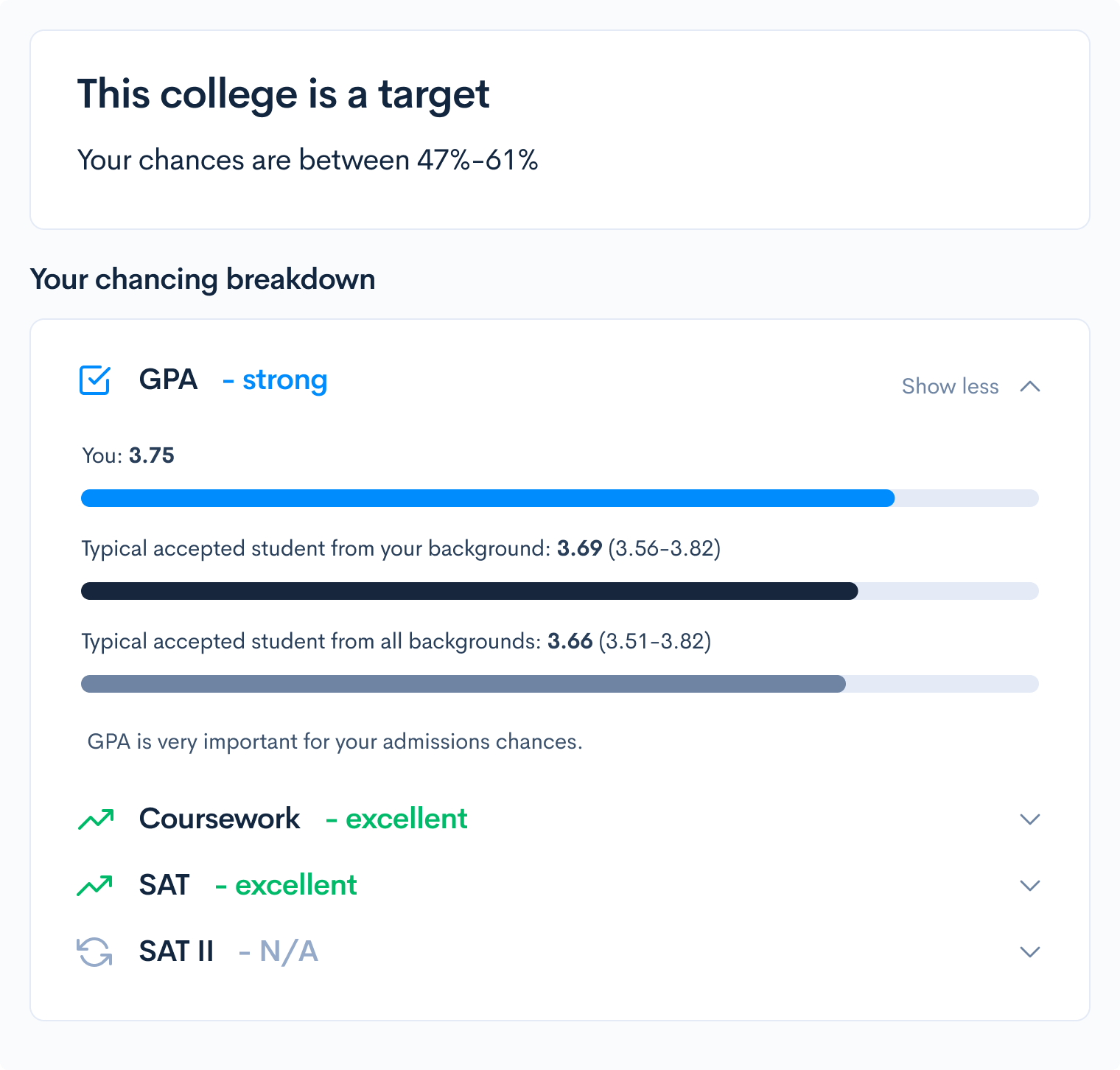
To better understand your chances of acceptance at Tulane University, we recommend using our free admissions calculator. This helpful tool will use your background, grades, test scores, extracurriculars, and other factors to estimate your odds of acceptance. It will also give you tips on how to enhance your profile to improve your chances of admission.
The calculator also helps you identify best-fit schools by filtering factors like location, majors, size, and more—so you can build a college application strategy that works for you.